Emerson Cutler Majestic Theatre, Boston, MA.
November 22, 2026.
The first time I see a particular dance company perform is always an interesting one; I come in with few to no preconceived notions about what I’m about to see. It’s often refreshing to see the unique voice of a new (to me) group of artists.
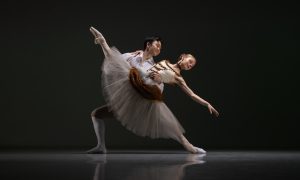
Vancouver’s Ballet BC, presented through Boston’s Vivo Arts, demonstrated this sort of singular voice. Innovation and risk-taking characterized each of the program’s three works. Choices in concept, movement vocabulary and atmosphere carried such risk-taking into satisfying final product.
Working with students from Boston Conservatory also reflected a certain passing of the baton to the next generation – bridging gaps from pre-professional to professional artists.
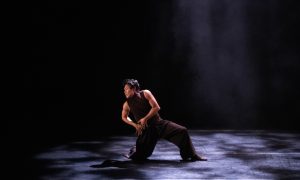
Medhi Walerski’s enticing Sway (2019) kicked off the program. The work gradually built, pedestrian movement developing under warm yellow light. Through counterbalance, one dancer helped another rise to her feet (that would be meaningful later). The group dispersed, and a soloist upped the ante on athleticism: in speed, expansiveness, and layering of movement.
In solitary kinetic exploration, the fluidity and accent in his articulations: quite entrancing. He soon moved with a duet partner, bringing that enticing complexity into the possibilities of two bodies – including the relationships between them as they navigated space. A later group section organized dancers in space and time such that simultaneous, yet varied action remained legible.
The work offered windows into each of these varied orientations of dancers in space, each effective in their own ways. Similarly, through all of these separate sections, the work offered a full buffet of different tones and textures.
Particularly memorable was a breathy duet towards the end; the pair’s breath was audible, and also showed in the lift and release of their spines as they moved. Gestures of opening and closing, limbs slicing and redirecting: these actions were fresh and pleasing on a body level, and also seemed to support the work’s energetic ebbs and flows.
The score (by Adrien Cronet) infused something mysterious, and shadow juxtaposed that warm yellow light: an atmosphere of unsettled, uncertain mood. Somehow all of these disparate ingredients cohered to create something rather enjoyable. The work thus exemplified how non-narrative, abstract work can offer something simply through that cohering of different elements into something singular, something to uniquely pique the senses and mind.
Structure can certainly be part of that process, and this work’s ending brought that home. A dancer settled back on her side, eased towards that position by her partner’s counterbalance, as the curtain slowly lowered: a retrograde of the opening.
This was the same pair that performed the action, in reverse, at the beginning – yet they did so alone, rather than in a line of dancers. One could dissect and conjecture myriad meanings from all of those details. The choice was also intriguing on a structural level, and affecting on a kinetic and sensory one: both valid, both available to savor from this work.
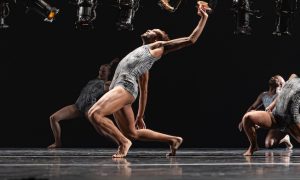
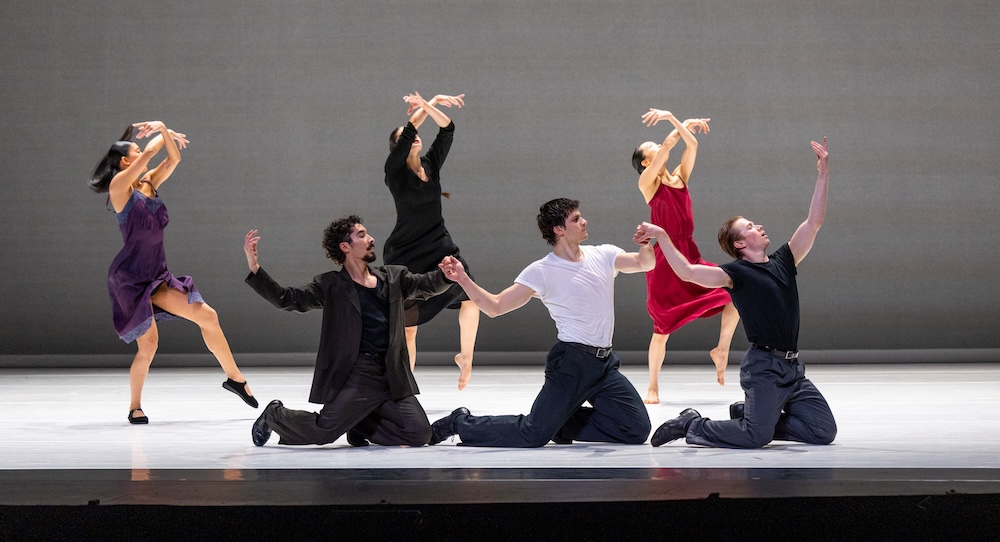
Next came Bobbi Jene Smith and Or Schraiber’s Obsidian (2025): bold, raw, and sensual. The stage was bright, much brighter than in the last work (lighting design by the choreographers), with highly pedestrian costuming (also by Jene Smith and Schraiber). Dancers faced an onstage piano. Like seeing a (certainly much more benign) Chekhov’s gun, I wondered if the piano would be played live. Indeed it was – and the dancers moved, with highly attuned musicality, to its eclectic tones.
Their movement, most often in duet pairs, was at times borderline aggressive in its tenacity and turbulence. Sultry moments embodied deep, ferocious desire. Shifting articulations through the body, expansion through space, vacillating between internal and external focus: all restless, all enthralling.
Other moments offered simpler quotidian comedy, eliciting a few rounds of laughter from audience members. Infusions of suave cool offset the ferocious and tenacious at hand. Highly inventive movement vocabulary – muscular, visceral, versatile – could hold all of these dualities and dichotomies. The commanding ensemble delivered the kinetic artistry necessary to hold all of that, as well.
Like Sway, the work exhibited something abstract and non-narrative – yet that did not mean lack of embodied meaning. A duet toward the end offered more tenderness than seemed evident in the work thus far: spines softening towards each other, hands crossing behind and finding contact for support. Also like in Sway, the movement innovation at hand allowed these separate layers to shine through in novel, engaging ways.
To end the work, dancers faced the piano: a choice perhaps merely spatial, yet I saw an allusion to the work’s keen musicality. It felt almost as if the dancers were acknowledging the music that they aligned with, that they brought to tangible life, throughout: a lovely thought on cross-media collaboration, inspiration, and mutual respect.
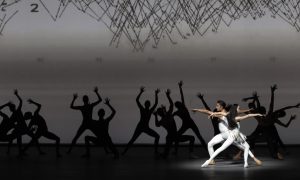
The electric Bolero X (2023), from Shahar Binyamini, leveraged a large ensemble to create sophisticated spectacle. The program notes claimed that the work aimed for something mesmerizing: check check, achieved! Like with the program’s two prior works, innovation on the body level was certainly part of that effect.
Inventiveness of concept also helped create something spellbinding. Earthy contemporary movement set to the classical Boléro (from Maurice Ravel)? If the result pleases the senses and builds a pleasing energetic experience, why not?
Early in the work, solos and duets presented notably layered movement – which then escalated in athleticism. The ensemble, forming a three-sided square open to the audience, moved with simple articulations as one or two of their own took the cypher’s center. These sections also displayed a strong exploratory sense, through the body and through space.
The height of spectacle came as the dancers all moved together, blanketing the stage in their energy of flesh and momentum. They were highly unified – in timing, shaping, and in spatial relation – yet also individuals applying their own movement signatures.
They infused a touch of Jene Smith and Schraiber’s sensuality and keen visceral sense: creating body percussion, applying self-touch such as a hand drawing across the chest. They journeyed through assorted layers of visceral experience, taking us on the path with them as witnesses.
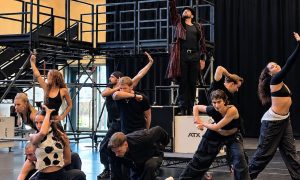
My favorite part of the work, however, was Boston Conservatory dancers dancing with Ballet BC company members. If I really focused, I could distinguish certain dancers that might be in conservatory – mostly from slightly more youthful appearance. Otherwise, they blended right in. What an experience for these rising artists: to learn from, to support and be supported by, a company of professionals!
That sort of nurturance of the next generation fit right in with the program’s innovative, bold ethos. Something from a “ballet” company needn’t be stuffy, erudite, or exclusive. It might need to not be in order for those “BoCo” dancers, and all in their generation, to have bright artistic prospects ahead of them. Ballet BC’s Boston run demonstrated that concert dance doesn’t have to be stuck in the past; it could actually lead the way into the future. How exciting!
By Kathryn Boland of Dance Informa.
Share this: